
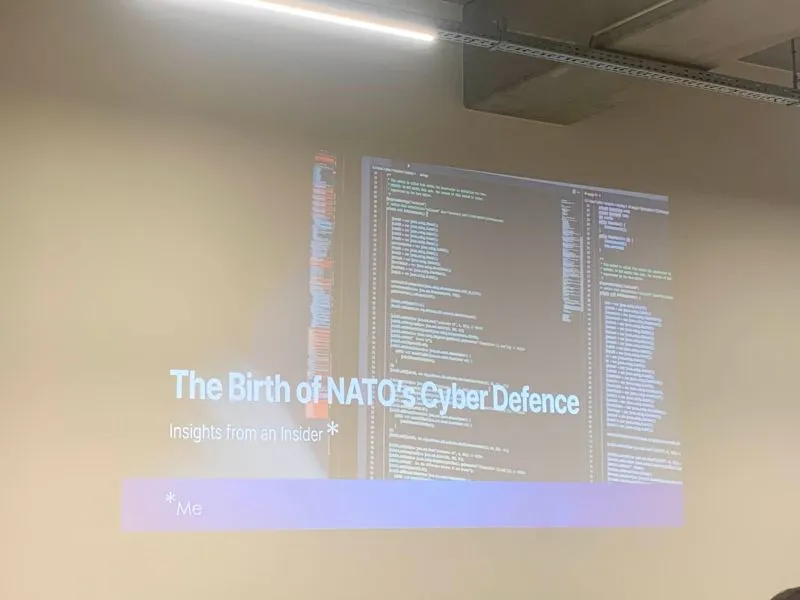
The Birth of NATO’s Cyber Defence: Notes from a Howest Tech & Meet
One of the things I appreciate most about studying in this field right now is the access we get to people who were actually in the room when the big decisions were made. A recent Howest Tech & Meet evening was exactly that kind of opportunity. The session was called “The Birth of NATO’s Cyber Defence: Insights from an Insider,” and it delivered on the title.
The Tech & Meet Format
Howest runs these Tech & Meet evenings as a way to bring students, alumni, and industry people together around a single speaker and a single topic. They’re relaxed, they’re free to attend, and the value is in hearing directly from someone with deep firsthand experience rather than reading a sanitized summary years later. This one drew people in for a subject that’s become impossible to ignore: how a military alliance built to deter tanks and missiles learned to defend an invisible domain.
The Speaker
The talk was given by ir. Martin De Pauw, and his background is exactly why the evening worked. He graduated from the Polytechnic division of the Royal Military Academy in 1989 and started his career in F16 avionics. From there he moved into the world of software, hardware and networks, and eventually took on serious responsibility inside NATO’s cyber effort.
That career arc matters. He didn’t come at cyber as a lifelong hacker or as a policy academic. He came at it as an engineer who watched the threat landscape change underneath him and had to help an enormous international organization adapt to it in real time. That gave the whole talk a grounded, practical feel.
The Story: From Nerds to Everyone’s Reality
De Pauw opened with a framing that stuck with me. Cyber used to be seen as something for nerds and techies, a playground for the young and curious. Today it’s everyone’s reality. Cyber has no borders. It doesn’t care about age, gender, or color. It connects us all and exposes us all at the same time, and it has no limit on whether it’s used for good or bad.
That shift, from niche curiosity to something that touches every part of military and civilian life, is the backdrop for the entire NATO cyber story. Software, hardware, networks, clouds, and now AI are evolving faster than ever, and every leap forward in capability is also a leap forward in attack surface. Wherever there’s good intent, someone is looking to exploit it.
2016: The Pivotal Year
The heart of the talk was the year 2016. At the Warsaw Summit, NATO made a historic move and officially recognized cyberspace as a domain of operations, putting it alongside land, sea, and air. It’s easy to skim past that as a bureaucratic line, but De Pauw made it clear how significant it really was.
Recognizing cyberspace as an operational domain meant that an attack in the digital realm could be treated with the same seriousness as a physical one. It meant cyber defence was no longer an IT support function tucked away in a basement, it was now part of the alliance’s core mission of deterrence and defence. Everything that followed, the policies, the centres, the exercises, the partnerships with industry and academia, flowed from that decision.
De Pauw walked through the challenges that had to be overcome to get there and beyond. Building cyber capability across a multinational alliance is not a technical problem alone. You have many nations, each with their own systems, their own laws, and their own sensitivities about sharing information. He emphasized how crucial collaboration with international military and civilian experts turned out to be. The recurring theme was that none of this works in isolation. As NATO itself likes to put it, no single nation is better equipped to face cyber threats than all of them together.
Where It Stands Today
From that 2016 turning point, the talk traced NATO’s journey from digital uncertainty toward genuine cyber resilience. Today the alliance has grown to 32 nations, and cyber defence has become a cornerstone of its mission to protect them. The direction of travel has been consistent: more integration, more situational awareness, more shared responsibility.
What I took away is that resilience, not perfection, is the goal. There is no such thing as a completely secure network, and the organizations that handle this best are the ones built to keep functioning even when their networks are under attack. That’s a mindset shift from “keep everything out” to “expect intrusion and stay operational,” and it applies just as much to a company as it does to a military alliance.
Why It Mattered to Me
As a student heading into security, it’s one thing to read that cyberspace became an operational domain in 2016. It’s another to hear someone explain what that actually meant on the ground, what had to change, and how much of it came down to people from different countries and backgrounds learning to trust and work with each other.
The talk connected technology, strategy, and global security in a way that a textbook can’t. It also reframed cyber for me as something fundamentally human and collaborative, not just a stack of tools and exploits. The invisible domain of cyberspace has become one of the most consequential battlefields of our time, and getting to hear that history from someone who lived it was a genuine privilege.
Thanks to Howest for putting these evenings on. This is exactly the kind of thing that makes studying here worthwhile.
“The Birth of NATO’s Cyber Defence: Insights from an Insider” was a Howest Tech & Meet session presented by ir. Martin De Pauw. NATO recognized cyberspace as a domain of operations at the 2016 Warsaw Summit.